



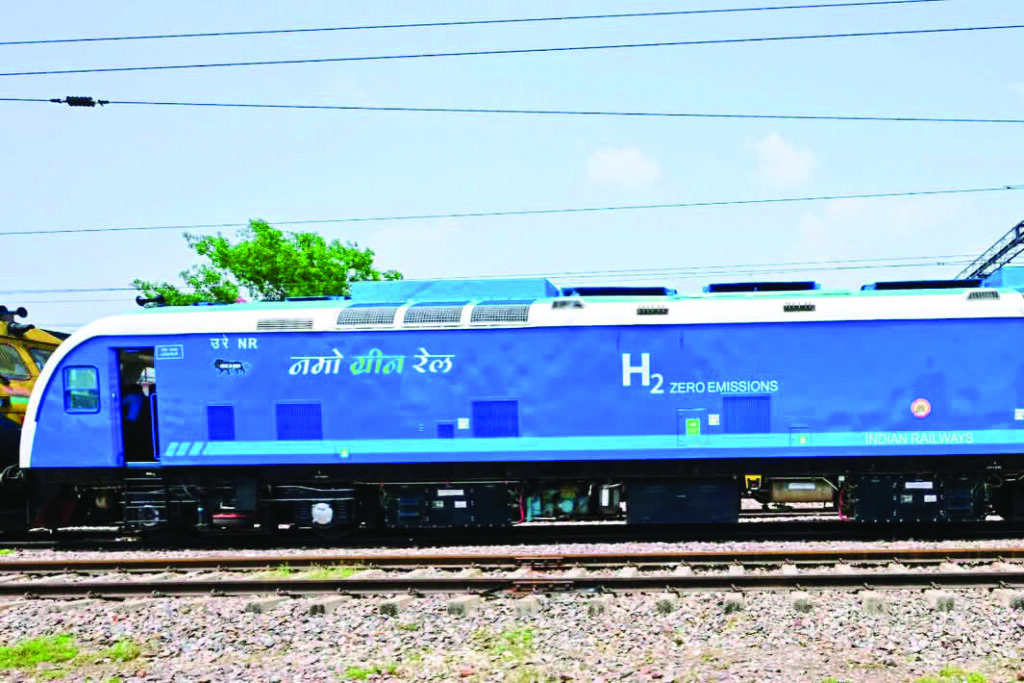
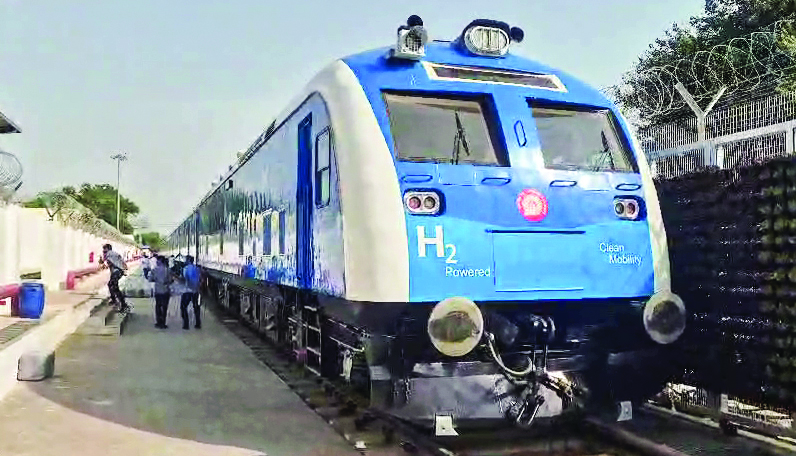
As India celebrates another Independence Day, one of the country’s most significant scientific achievements has quietly begun its journey across the plains of Haryana. Flagged off by Prime Minister Narendra Modi, India’s first indigenously developed hydrogen-powered train is, at one level, another addition to the nation’s vast railway network. At another, it represents something far more profound. It marks India’s entry into a select group of nations developing one of the world’s most promising clean-energy technologies through indigenous engineering.
The train itself is remarkable. Operating on the Jind–Sonipat section of Northern Railway, the 10-coach train is powered neither by diesel nor by overhead electric wires. Instead, two hydrogen-powered driving cars—one at each end—together generate 2,400 kW of power. The train carries nearly 2,600 passengers at speeds of up to 75 kilometres an hour while emitting only water vapour and heat. Yet its real significance lies beyond railway transportation. It signals India’s growing ability to design, integrate and deploy advanced technologies that could strengthen the country’s energy security, industrial competitiveness and scientific capabilities.
Hydrogen has long fascinated scientists. The lightest and the most abundant element in the universe possesses an exceptionally high energy content by weight. When produced using renewable electricity and used in fuel cells, it offers one of the cleanest methods of generating power. For decades, however, hydrogen remained more a scientific promise than an engineering reality. Producing it economically, storing it safely and converting it efficiently into electricity presented formidable technological challenges.
Rapid advances in renewable energy, electrochemistry, materials science and fuel-cell engineering are now changing that picture. Governments across the world increasingly view hydrogen as an essential component of future clean-energy systems, particularly for sectors where batteries alone cannot provide practical solutions.
WHY HYDROGEN MATTERS
The transition to clean energy is often associated with solar panels, wind turbines and electric vehicles. These technologies are transforming the global energy landscape, but they cannot solve every problem. Heavy industries such as steel, cement and fertilisers require enormous quantities of continuous energy. Long-distance freight transport, shipping and aviation demand energy sources that combine high energy density with long operating ranges. Batteries become increasingly heavy and less efficient in such applications.
Hydrogen offers an alternative pathway. Electricity generated from solar or wind energy can be used to split water into hydrogen and oxygen through electrolysis. The hydrogen can then be stored, transported and converted back into electricity whenever required. It thus serves as a clean energy carrier, overcoming one of renewable energy’s greatest limitations—its intermittent availability.
Many scientists therefore regard hydrogen not as a competitor to electricity but as its natural complement. Electricity will continue to power homes, offices and much of urban transport, while hydrogen is expected to play an increasingly important role in industries and transport systems that require greater energy density and operational flexibility.
India is particularly well placed to benefit from this transition. The country enjoys abundant sunshine, rapidly expanding renewable-energy capacity and among the world’s lowest solar power costs. It is also already a major consumer of hydrogen in petroleum refining and fertiliser production. The National Green Hydrogen Mission seeks to build upon these strengths, with the ambitious objective of producing five million tonnes of green hydrogen annually by 2030, while encouraging domestic manufacturing, scientific research and technological innovation.
INSIDE INDIA’S HYDROGEN TRAIN
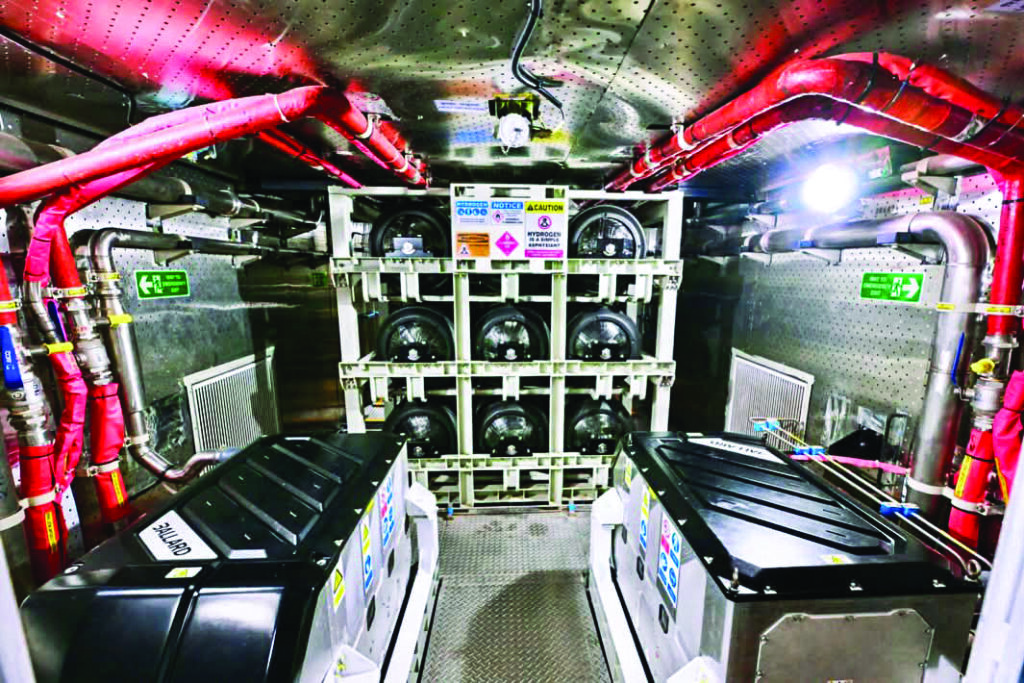
Although it resembles a conventional passenger train from the outside, the technology within is fundamentally different. Hydrogen is stored in specially designed cylinders at a pressure of 350 bar. It is then supplied to Proton Exchange Membrane (PEM) Fuel Cells, where hydrogen combines electrochemically with oxygen from the atmosphere to generate electricity. Unlike a diesel engine, nothing is burnt. Electricity is produced directly through an electrochemical reaction, making the process both efficient and environmentally clean.
The fuel-cell system works in tandem with advanced lithium iron phosphate batteries, which respond instantly to changes in power demand during acceleration, braking and varying gradients. While the batteries provide immediate bursts of power whenever required, the fuel cells continue operating under relatively stable conditions, improving efficiency and extending the life of the entire propulsion system. Sophisticated power electronics continuously regulate energy flow between the fuel cells, batteries and traction motors to ensure smooth operation.
All Images Courtesy: Twitter
Safety, understandably, has been a major engineering priority. Hydrogen is highly combustible, but modern engineering has developed robust safeguards for its storage and handling. High-pressure cylinders are manufactured to stringent international standards, while sensitive leak detectors, flame sensors and automated isolation systems continuously monitor the entire installation. Indian Railways has also established an integrated hydrogen production, compression, storage and dispensing facility at Jind, licensed to handle compressed hydrogen and capable of storing nearly 3,000 kilograms of hydrogen. Together with carefully designed operating procedures and trained personnel, these measures ensure that hydrogen can be handled with a high degree of safety.
The hydrogen train is therefore not merely another locomotive. It is a sophisticated engineering platform that integrates electrochemistry, materials science, mechanical engineering, electronics, software, battery technology and railway operations into a single system. It also demonstrates how advances in multiple scientific disciplines converge to create practical solutions for the clean-energy transition.
THE REAL ACHIEVEMENT: BUILDING THE TECHNOLOGY AT HOME
The most remarkable aspect of India’s hydrogen train is not simply that it runs on hydrogen. It is that the technology has been developed substantially through indigenous engineering. Rather than relying entirely on imported systems, Indian Railways chose the more demanding path of building capability within the country.
This required Indian engineers to solve a series of complex challenges. Hydrogen had to be stored safely under high pressure, fuel cells had to be integrated with electric traction systems, batteries had to work seamlessly with onboard power management, and every component had to meet the exacting safety and reliability standards of railway operations. The result is not merely a successful train but a valuable body of engineering knowledge that can support future innovations across several sectors.
The achievement is significant for another reason. India did not simply replicate technology developed elsewhere. It adapted hydrogen propulsion to the country’s own railway conditions, including its broad-gauge network, larger passenger capacity and operational requirements. Engineering is rarely about copying solutions; it is about designing solutions that work under local conditions. In that respect, the hydrogen train represents an important milestone in India’s technological maturity.
Equally noteworthy is the emphasis on affordability. Breakthrough technologies change societies only when they become economically viable. By leveraging domestic engineering expertise and existing institutional capabilities, Indian Railways has shown that advanced clean-energy technologies can be developed with careful attention to cost. The entire project is reported to have cost Rs 136 crores, almost one third of what Germany spent in developing the same technology. India’s reputation for delivering high-quality engineering solutions with exceptional cost efficiency—from space missions to digital public infrastructure—finds another expression in this project.
The true value of indigenous development lies not only in reducing dependence on external suppliers but also in creating scientific capability within the country. Every fuel cell tested, every software system validated and every engineering problem solved strengthens India’s knowledge base and creates opportunities for future innovation.
BEYOND RAILWAYS
Despite the excitement surrounding the hydrogen train, railways are unlikely to become the largest users of hydrogen in India. Nearly 99 per cent of the country’s broad-gauge railway network has already been electrified, making electric traction the preferred solution for most routes. Hydrogen-powered trains will be particularly useful on heritage railways, mountain sections and isolated routes where conventional electrification is technically difficult or economically impractical.
THE LARGER OPPORTUNITIES LIE ELSEWHERE
Steel manufacturing, fertiliser production, petroleum refining, heavy commercial vehicles, mining equipment, shipping and eventually even aviation are among the sectors where hydrogen could play a transformative role. These industries are among the most difficult to decarbonise and account for a substantial share of global carbon emissions. Green hydrogen offers one of the few practical pathways for reducing their environmental footprint while sustaining industrial growth.
Hydrogen can also serve as a means of storing renewable energy. Electricity generated during periods of abundant sunshine or strong winds can be converted into hydrogen, stored for extended periods and used whenever required. In this way, hydrogen complements renewable energy by improving the reliability and flexibility of future power systems.
The hydrogen economy therefore extends far beyond transportation. It encompasses electrolysers, fuel cells, advanced materials, storage systems, specialised sensors, power electronics, digital controls and new manufacturing processes. Together they form an industrial ecosystem capable of generating new enterprises, skilled employment and technological innovation.
ENGINEERING INDIA’S ENERGY FUTURE
Scientific progress is measured not merely by the machines a nation acquires, but by the knowledge it creates to build the next generation of machines. That is perhaps the most enduring lesson of India’s first hydrogen train.
Energy security has become one of the defining strategic challenges of our age. Recent geopolitical conflicts have repeatedly demonstrated the economic vulnerabilities associated with dependence on imported fossil fuels. Nations that master alternative energy technologies strengthen not only their environmental credentials but also their long-term economic resilience and strategic autonomy.
India enters this transition with important advantages. It possesses abundant renewable energy resources, a rapidly expanding scientific base, internationally respected engineering talent and one of the world’s largest potential domestic markets for green hydrogen. If these strengths are combined with sustained investment in research, advanced manufacturing, skilled human resources and industrial innovation, India can emerge not merely as a consumer of hydrogen technologies but as one of their leading developers.
Germany pioneered operational hydrogen trains, while several other countries continue to experiment with different technological pathways. India’s distinctive contribution lies in demonstrating how hydrogen technology can be developed substantially through indigenous engineering and integrated into the needs of one of the world’s largest railway systems. More importantly, it has linked this achievement with a broader national vision for clean energy and industrial transformation.
Launched a few weeks before 15th August, India’s Independence Day, the hydrogen train offers a glimpse of how the meaning of national progress continues to evolve. Political independence gave the nation the freedom to determine its own future. Economic reforms expanded its opportunities. The coming decades will increasingly be shaped by scientific excellence, engineering capability and technological innovation.
The train now running across the plains of Haryana is therefore much more than a new mode of railway propulsion. It is evidence of a nation investing with confidence in science, engineering and its own creative abilities.
Whether hydrogen ultimately powers thousands of trains or finds its greatest impact in steel plants, fertiliser factories, ships, heavy transport or energy storage, one fact is already clear. India is no longer content merely to adopt the technologies that will shape the future. Increasingly, it seeks to help create them.
That may well prove to be the most enduring significance of India’s first hydrogen train.
* The writer, a Harvard educated civil servant, is a former Secretary, Ministry of Information & Broadcasting, Government of India. He also served on the Central Administrative Tribunal and as Secretary General of ASSOCHAM. He commands extensive expertise in the fields including Media and Information, Industrial and Labour Reforms, and Public Policy.