
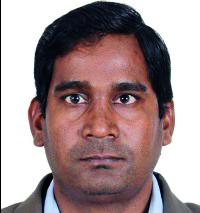
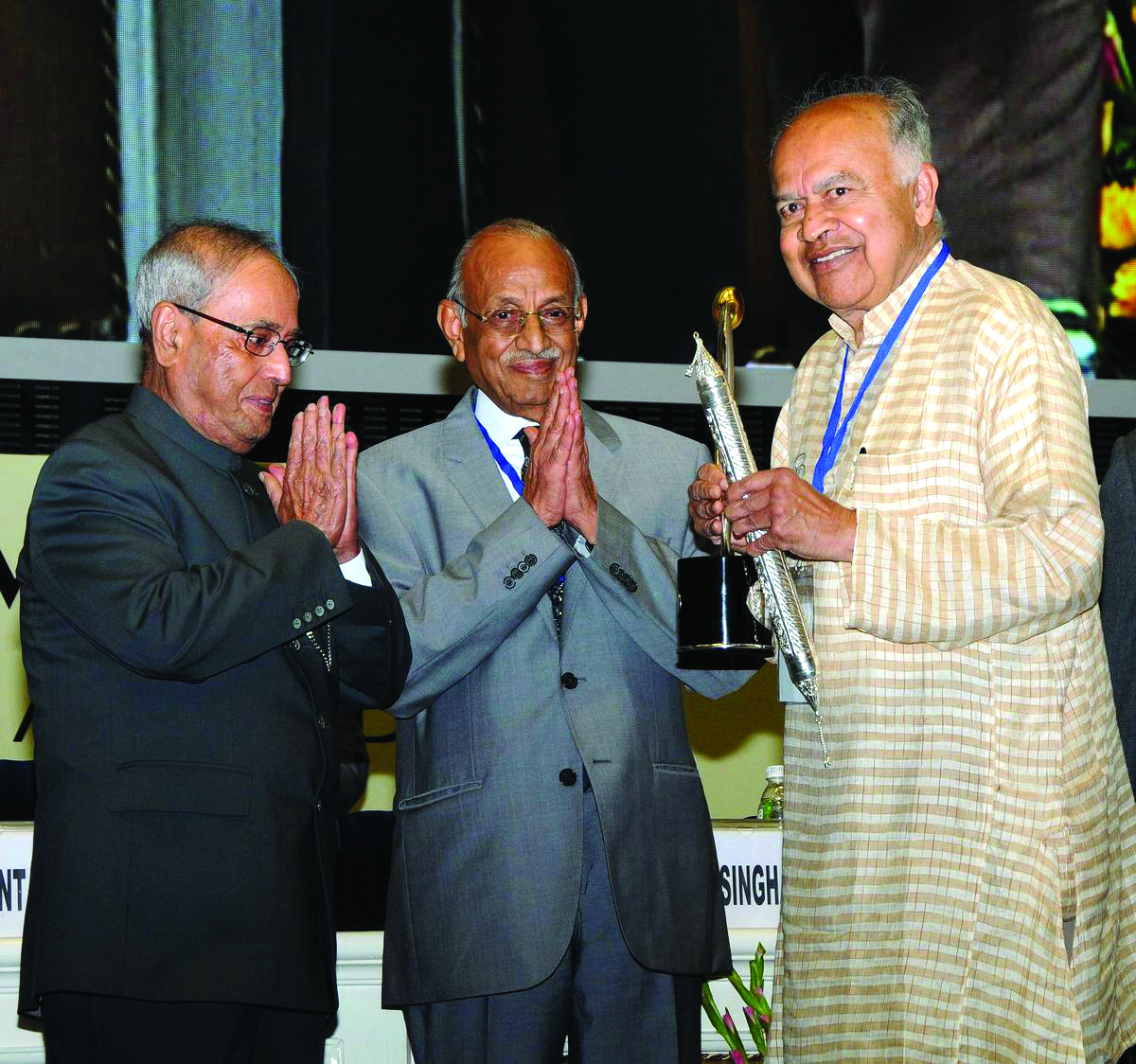
Image Courtesy: Wikimedia Commons
REMEMBERING PROF JAYANT VISHNU NARLIKAR (1938-2025)
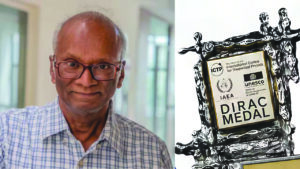
The growth of modern astronomy and cosmology in India owes much to Prof Jayant Vishnu Narlikar, one of the country’s foremost astrophysicists. Internationally acclaimed for his pioneering work in theoretical cosmology, he combined scientific excellence with a lifelong commitment to science education and public outreach. Over six decades, he advanced cosmological research, built world-class institutions, mentored generations of scientists, and inspired the public through his books and lectures.
At a time of revolutionary advances in cosmology, Narlikar distinguished himself by challenging prevailing theories and developing alternative models of the universe. His long collaboration with Sir Fred Hoyle brought him international recognition, while his vision led to the establishment of IUCAA in Pune, now one of India’s leading centres for astronomy research and education. His career exemplifies the integration of scientific excellence, institution building, education, and public service.
FORMATIVE YEARS AND AWARDS
Jayant Vishnu Narlikar was born on 19 July 1938 in Kolhapur, Maharashtra, into a family deeply devoted to scholarship and learning. His father, Prof Vishnu Vasudev Narlikar, was a distinguished mathematician and theoretical physicist at Banaras Hindu University (BHU), while his mother, Sumati Narlikar, was a renowned Sanskrit scholar. Growing up in such an intellectually stimulating household naturally nurtured his curiosity, discipline, and love for knowledge. Much of his childhood was spent on the BHU campus, where his father’s residence frequently hosted eminent scholars, scientists, philosophers, and educationists. Distinguished visitors included Nobel laureate Sir C V Raman, physicist Meghnad Saha, mathematician D D Kosambi, educationist Dr Sarvepalli Radhakrishnan, Sir C D Deshmukh, Pandit Narendra Vyas, and BHU founder Pandit Madan Mohan Malaviya. Listening to discussions on mathematics, physics, philosophy, education, and national development gave the young Narlikar an invaluable intellectual foundation and fostered a lifelong passion for scientific inquiry.
An exceptionally gifted student, he completed his undergraduate studies in mathematics at BHU before moving to Fitzwilliam College, University of Cambridge, for higher education. At Cambridge, he graduated as a Senior Wrangler, one of the highest distinctions in the Mathematical Tripos examinations, reflecting his extraordinary mathematical ability. In 1963, he completed his doctoral research under the supervision of Sir Fred Hoyle, marking the beginning of one of the most influential collaborations in twentieth-century cosmology. Throughout his career, Narlikar received numerous honours recognizing both his scientific achievements and his contributions to science education. These included the Padma Bhushan (1965) at the age of just 26, Shanti Swarup Bhatnagar Award (1978), Indira Gandhi Award (Indian National Science Academy) (1990), UNESCO Kalinga Prize (1996), Padma Vibhushan (2004), Prix Janssen of the French Astronomical Society (2004), Maharashtra Bhushan Award (2010), the Smith’s Prize, Tyson Medal, Adams Prize, and several honorary doctorates from universities in India and abroad. Besides research, he was an accomplished writer whose science fiction, popular science books, essays, and autobiography introduced scientific ideas to readers across generations. His autobiography, A Tale of Four Cities (Chaar Nagaraantale Maajhe Vishwa), received the Sahitya Akademi Award.
RETHINKING COSMOLOGY
One of the defining aspects of Narlikar’s scientific career was his long collaboration with Sir Fred Hoyle, one of the twentieth century’s leading astrophysicists. Working with Hoyle allowed him to investigate some of the deepest questions concerning the origin, evolution, and large-scale structure of the universe.
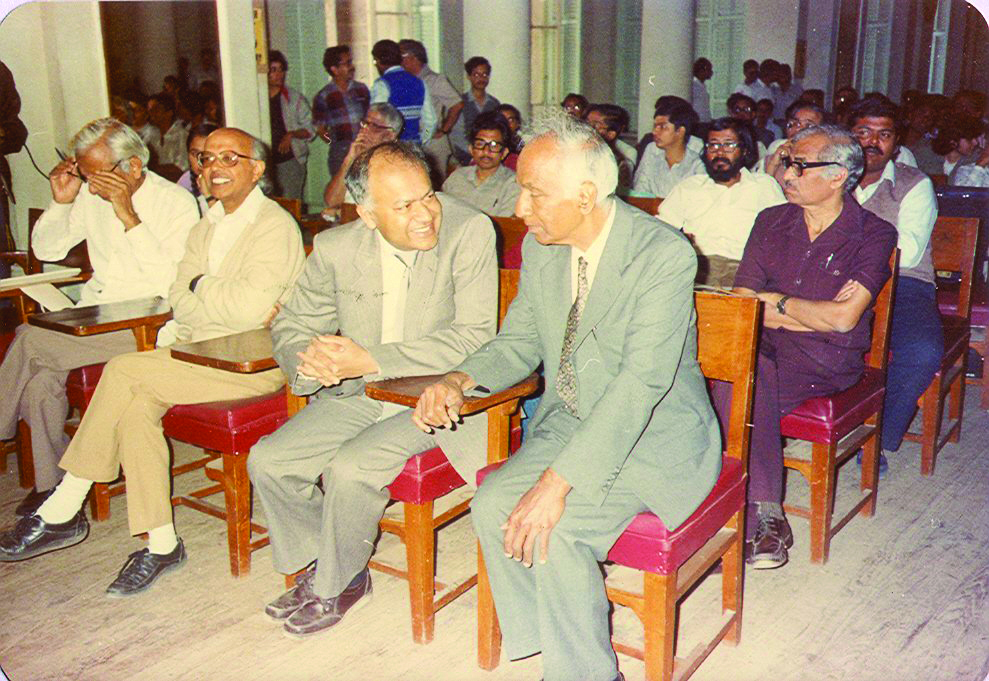
Image Courtesy: From free sources on the Internet
Together they developed the Hoyle–Narlikar theory of gravitation, an innovative framework that attempted to combine Einstein’s General Theory of Relativity with Mach’s Principle, which proposes that the inertia of an object is determined by the distribution of matter throughout the universe that led a notable contribution to the world scientific community. He became particularly well known for examining alternatives to the standard Big Bang model. Together with Hoyle and Geoffrey Burbidge, he later developed the Quasi-Steady State Cosmology (QSSC), which proposed that the universe undergoes continuous cycles of expansion accompanied by periodic matter creation instead of originating from a single primordial explosion. Although the Big Bang model remains the dominant cosmological framework today, Narlikar’s work demonstrated the importance of questioning established theories and testing competing ideas through observation and mathematical analysis. His scientific contributions significantly enriched modern cosmology by encouraging critical thinking and rigorous debate.
FOUNDING OF IUCAA
In 1972, Narlikar returned to India and joined the Tata Institute of Fundamental Research (TIFR) in Mumbai as a professor. At TIFR, he established a vibrant theoretical astrophysics group that attracted talented students and researchers from across the country. Many of his students later became leading scientists, reflecting his lasting influence as a mentor and teacher. Perhaps his greatest institutional contribution came in 1988, when he became the founding director of the Inter-University Centre for Astronomy and Astrophysics (IUCAA) in Pune. He envisioned IUCAA as a national centre that would bridge the gap between universities and advanced research institutions by providing students and faculty members access to modern research facilities, expert guidance, and collaborative opportunities.
Under his leadership, IUCAA rapidly gained international recognition for excellence in astronomy and astrophysics. Today, IUCAA remains one of India’s foremost astronomical institutions and stands as a lasting tribute to Narlikar’s vision, leadership, and dedication to strengthening scientific research in the country.
SCIENCE FOR EVERYONE
Prof Narlikar believed that science should reach beyond laboratories and classrooms. A gifted science communicator, he explained complex ideas with remarkable clarity through books, articles, science-fiction novels, lectures, television, radio, and newspaper columns in English, Marathi, and Hindi. His outreach inspired generations of students and readers to embrace scientific temper and rational inquiry.
A strong advocate of scientific temper, Narlikar consistently promoted evidence-based reasoning and encouraged people to question extraordinary claims through careful observation and experimentation. His public evaluation of astrological claims using controlled scientific methods reflected his commitment to critical thinking rather than opposition to cultural traditions. Throughout his life, he encouraged young minds to cultivate curiosity, ask meaningful questions, and seek answers through scientific investigation.
HIS LEGACY
Prof Narlikar remained actively engaged in research, education, and science outreach throughout his life. Even after retiring from administrative responsibilities, he continued writing, delivering lectures, mentoring young researchers, and participating in scientific discussions. He passed away in Pune on 20 May 2025 at the age of 86, leaving behind an extraordinary scientific and educational legacy. He is remembered not only as a pioneering cosmologist but also as an inspiring teacher, institution builder, prolific author, and passionate advocate of scientific temper.
Prof Narlikar’s pioneering contributions to cosmology, scientific institutions, education, and scientific temper have secured his place among India’s foremost scientists, inspiring generations to come.
*Dr Main Pal is an Assistant Professor at the Department of Physics, Sri Venkateshwara College, Delhi University, and can be reached at mainpal@svc.ac.in. Dr Hemwati Nandan is a Professor of Physics and Director, Research & Development Cell, HNBGU, Srinagar-Garhwal, Uttarakhand, and can be reached at hnandan@associates.iucaa.in. Both the authors also serve as Research Associates under the Associateship Programme of IUCAA, Pune, and they conduct research in diverse areas of astrophysics. Dr Pal earned his PhD from IUCAA, where both the authors had the privilege of interacting with Prof Narlikar on several occasions.