



Image Courtesy: NASA/ Wikipedia/ Public Domain
The scientists have found the first atmosphere surrounding an Earth-like, rocky planet orbiting within the habitable zone of a distant star.
The researchers say that their discovery provides the strongest evidence yet that worlds with conditions similar to Earth could exist beyond our solar system. The gas detected in the atmosphere is helium, which would not be able to support life, but other gases may also be present.
According to news reports, the astronomers have found the first confirmed atmosphere around a rocky planet in another star’s habitable zone. The exoplanet, LHS 1140 b, revealed its atmosphere through helium slowly leaking into space. Located 48 light-years away, the world may have preserved its atmosphere for billions of years, making it a promising target in the search for potentially habitable planets.
The discovery offers the strongest evidence so far that planets with broadly Earth-like temperatures and rocky compositions may exist beyond our solar system while also retaining conditions that could potentially support life.
WHAT IS AN EXOPLANET?
An exoplanet is any planet locate outside our solar system. Most of these worlds orbit other stars in the universe. LHS 1140b is one such exoplanet.
EXOPLANET ATMOSPHERE
The study, published on 16 July in the academic journal –Science, describes observations of helium escaping from LHS 1140 b, a rocky exoplanet located about 48 light-years from Earth. The signal supports earlier theoretical predictions that the planet possesses an atmosphere.
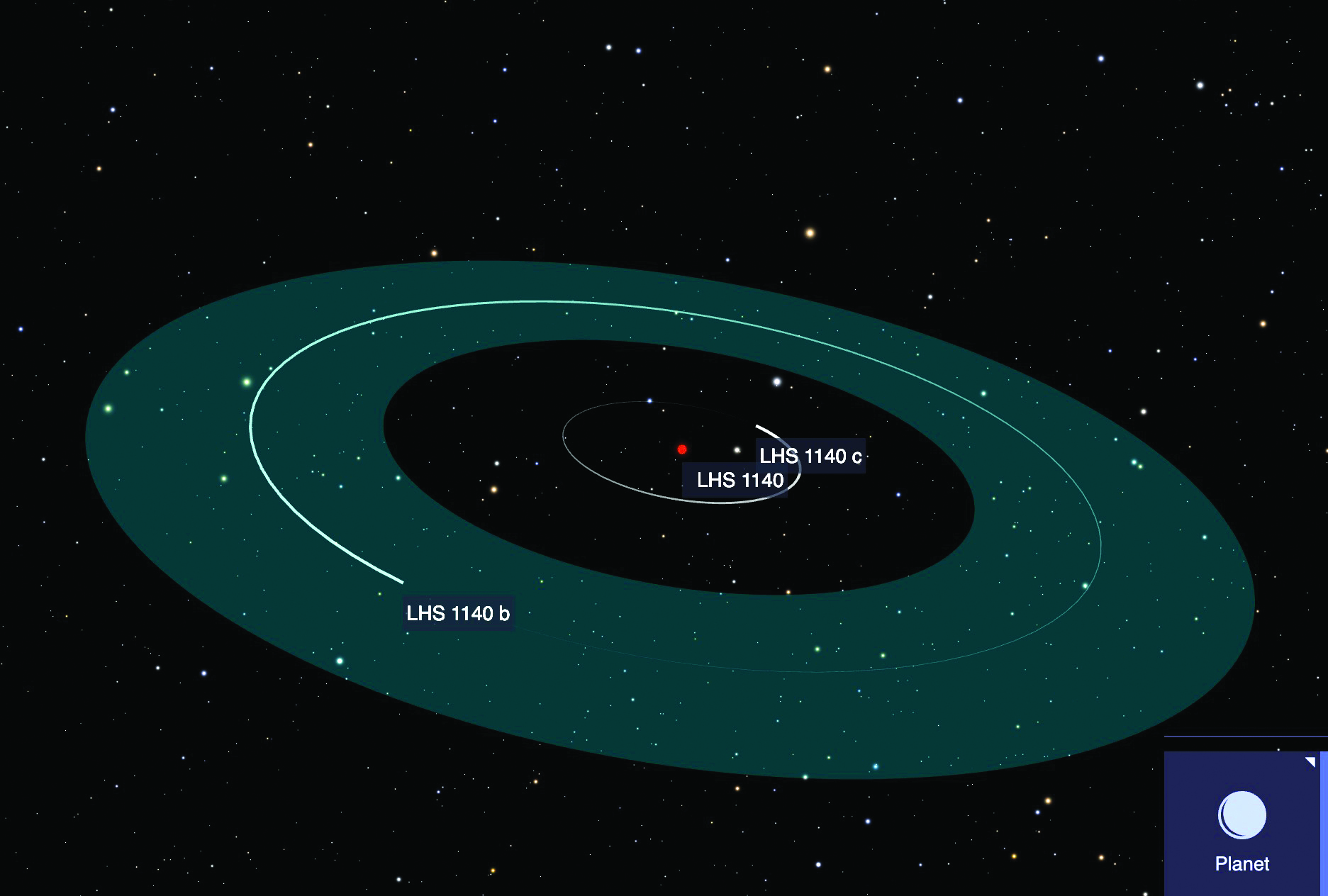
LHS 1140 b circles a red dwarf star within its habitable zone. This is the region around a star where temperatures and other environmental conditions may allow liquid water to remain on a planet’s surface.
Scientists have identified thousands of exoplanets, including several rocky worlds in habitable zones. However, confirming whether those planets have atmospheres has been one of the most difficult challenges in exoplanet research.
CHARACTERISTICS
LHS 1140 b has been detected using both the radial velocity method (which measures the mass of a companion object) and transit photometry (which determines radius). Because of this, LHS 1140 b is one of very few potentially habitable exoplanets with a determined mass and radius. The planet’s radius is well-constrained at 1.730±0.025 R (R is earth radius), equivalent to about 11,000 km. Its radius is similar to that of Kepler-62e.
With a greenhouse effect at least as strong as Earth’s, LHS1140 b would have a surface temperature greater than 266 K (−7 °C; 19 °F) for an albedo of 0. Due to the high mass of the planet, it likely has a thicker atmosphere with a more powerful greenhouse effect. Like many potentially habitable planets around red dwarfs, the orbit of LHS 1140 b is quite circular: the eccentricity is measured to be lower than 0.29 to a 90% confidence.
ROCKY WORLD AND ATMOSPHERE
To find that atmosphere on LHS 1140 b, astronomers used the 6.5-meter Magellan Telescopes in Chile, which recently had a new high-resolution spectrometer installed. When the planet passed in front of its parent star, the researchers saw starlight dropping in brightness at a wavelength known to be absorbed by helium. When a smaller planet in the system crossed, they saw no such signal.
*Curated from various news reports and the study published in Science journal.