


Image Courtesy: Twitter
In the current volatile geopolitical climate—marked by conflicts such as the Russia–Ukraine war and tensions in West Asia—energy insecurity has once again become a global concern. Among the most affected sectors is the cooking fuel, particularly Liquefied Petroleum Gas (LPG), which millions of households depend on daily globally. In India, where LPG is the backbone of domestic cooking, even minor disruptions can rip through the society. To understand the significance of this fuel, it is essential to trace the fascinating history of LPG and its bottling in cylinders that made its widespread use possible.
A VALUABLE WASTE GAS
The origins of LPG trace back to the early days of the petroleum industry. The first mention of a propane-and-butane mixture comes from 1910, when Walter O Snelling, an American chemist researching the properties of petrol, separated gaseous fractions from liquid ones, thus discovering the existence of propane. Two years later, he started his first domestic propane installation, and in 1913 he patented producing propane on an industrial scale. Later that year, the patent was bought by Frank Philips, the founder of the ConocoPhillips oil company. However, LPG consumption did not grow considerably.
Information concerning practical use of LPG dates to 1918, when the fuel was utilised for brazing lamps and metal-cutting blowtorches. However, commercial production did not begin until the 1920s. Scientists discovered that under moderate pressure, these gases could be converted into liquid form, drastically reducing their volume and making storage and transportation practical. This simple but transformative innovation allowed LPG to emerge as a usable fuel. What made LPG especially attractive was its clean-burning nature. Compared to traditional fuels like coal, firewood, and even gasoline, LPG produces fewer pollutants, burns efficiently, and leaves minimal residue. These properties quickly positioned it as a superior alternative for both domestic and industrial applications. In 1928, LPG was first used as motor fuel (in a truck), and the first LPG refrigerator was made. In 1929, as much as 10 million gallons of the fuel were being sold in the US. In 1932, it was used for cooking and heating water during the Los Angeles Olympic Games.
THE SCIENCE BEHIND LPG CYLINDERS
The familiar LPG cylinder is a product of decades of engineering refinement. Early designs focused primarily on strength and pressure resistance. Modern cylinders, however, incorporate advanced safety features such as pressure relief valves, improved sealing mechanisms, and ergonomic designs for easier handling. Safety has always been a central concern because LPG is stored under pressure. One of the most serious risks is the phenomenon known as a boiling liquid expanding vapour explosion (BLEVE), which can occur if a cylinder is exposed to extreme heat or structural failure. To minimise such risks, engineers use sophisticated analytical tools like fault tree analysis and computational modelling to predict and prevent failures. Materials science has also contributed, with stronger alloys and corrosion-resistant coatings enhancing durability. In recent years, innovation has moved toward ‘smart cylinders’. These include sensors that monitor gas levels, detect leaks, and even send alerts to users or suppliers. Some systems can automatically book refills when gas levels fall below a certain threshold, making LPG usage more convenient and safer.
HEALTH AND ENVIRONMENTAL BENEFITS
One of LPG’s greatest contributions lies in its impact on health. Traditional cooking fuels such as firewood, dung cakes, and charcoal produce large amounts of smoke, leading to household air pollution, as also respiratory and cardiovascular diseases. In India, before widespread LPG adoption, indoor air pollution was responsible for a significant disease burden, particularly among women and children. The shift to LPG has helped reduce exposure to harmful pollutants such as particulate matter and carbon monoxide. Environmentally, LPG burns more cleanly than biomass and coal, emitting lower levels of carbon dioxide and virtually no soot. Although it remains a fossil fuel, it serves as a transitional energy source, helping countries move toward cleaner energy systems. However, LPG is not without challenges. Leakage during storage and transport can release hydrocarbons into the atmosphere, contributing to air pollution and ozone formation. Addressing these issues requires improved infrastructure and stricter safety standards.
LPG IN INDIA
LPG was first introduced in India in December 1955 by Burmah Shell (now BPCL) in then Bombay, under the brand name ‘Burshane’. This initiative marked the beginning of a shift from traditional cooking methods to cleaner fuel, initially catering to households in Bombay, followed by the rest of Maharashtra state and Gujarat. The first Indane LPG connection in India was released on 22 October 1965, in Kolkata, marking the beginning of organised, modern cooking gas distribution by Indian Oil Corporation Ltd. Till the 1980s, LPG was largely limited to urban middle-and high-income households. However, policy interventions transformed their reach. One of the most significant initiatives was the Pradhan Mantri Ujjwala Yojana (PMUY), launched in 2016, which provided free LPG connections to women from low-income households. By 2023, over 9.6 crore (96 million) LPG connections had been distributed under the scheme. As a result, LPG coverage in India increased from about 55% in 2014 to over 97% of households today.
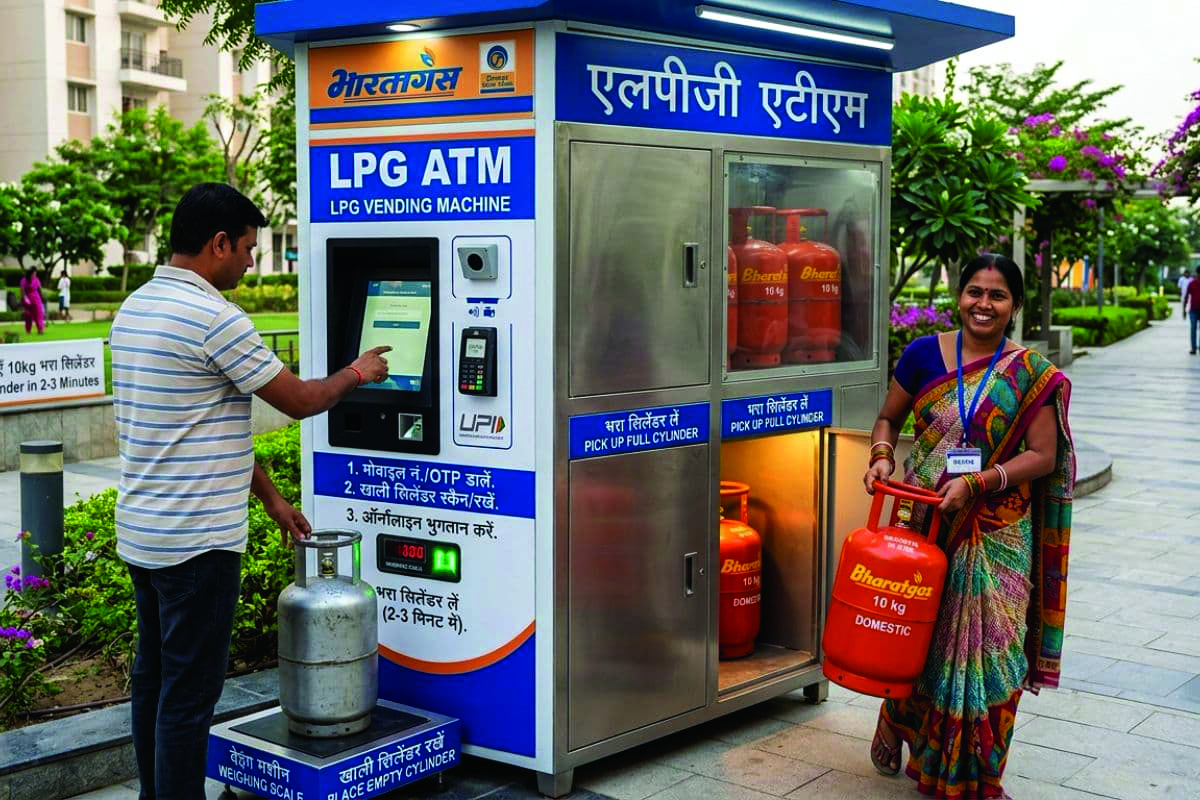
Recently, in March 2026, Bharat Petroleum Corporation Limited (BPCL) launched India’s first 24×7 LPG ATM in Sector 33, Gurugram (Sohna). Industrially, LPG has also gained importance as a fuel and a feedstock. It is used in heating, metal cutting, and as a raw material in petrochemical processes, where it can be converted into valuable chemicals like ethylene and propylene.
LPG ON THE MOVE: THE RISE OF AUTOGAS
LPG is not limited to kitchens; it is increasingly used as a transportation fuel, commonly known as autogas. In India, autogas has gained traction as a cleaner and more economical alternative to petrol and diesel. Vehicles running on LPG emit fewer greenhouse gases and pollutants, reducing carbon dioxide emissions by around 8–10% compared to gasoline. The Indian government has supported this transition through various policies. However, the adoption of LPG vehicles still faces hurdles, including limited refuelling stations, conversion costs, and consumer awareness. Despite these challenges, LPG holds promise as a transitional fuel in the transport sector.
TOWARD SUSTAINABLE LPG: THE EMERGENCE OF BIOLPG
As the world moves toward sustainability, researchers are exploring renewable alternatives to conventional LPG. One such innovation is bioLPG, produced from biomass and waste materials through advanced processes like hydropyrolysis. It is also called renewable propane and biopropane. BioLPG has the potential to deliver the same benefits as traditional LPG while significantly reducing carbon emissions. However, it is still in the early stages of adoption.
The journey of LPG—from an unwanted byproduct to a cornerstone of modern energy use—highlights the power of innovation and policy in shaping everyday life. The blue flame in a kitchen stove represents decades of scientific progress, policy effort, and social change, making it an enduring symbol of how energy can transform lives.
*Dr Jyothish Madambikattil Sasi is an assistant professor (RIC) at Garden City University, Bengaluru (jyothishmadambi@gmail.com) while Dr Biju Dharmapalan is the Dean- Academic Affairs, Garden City University, Bengaluru, and an adjunct faculty at the National Institute of Advanced Studies, Bengaluru, (bijudharmapalan@gmail.com)