



Image Courtesy: PIB
YOUNG SCIENTIST / PROF SURHUD SHRIKANT MORE
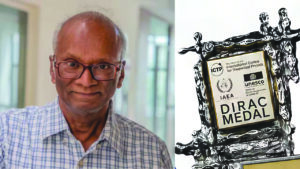
When the Government of India announced recipients of the Rashtriya Vigyan Puraskar 2025, one name stood out in the field of physics—that of Prof Surhud Shrikant More of the Inter-University Centre for Astronomy and Astrophysics (IUCAA), Pune. He was chosen for the prestigious Vigyan Yuva-Shanti Swarup Bhatnagar Award for his exceptional contributions to astrophysics and cosmology, particularly his work on galaxy formation, dark matter and the large-scale structure of the universe.
For Prof More, the award is the culmination of a journey that began in rural Maharashtra. Growing up in Alibaug, he was fascinated by science and astronomy from a young age. He has often spoken about how the legendary astrophysicist Prof Jayant Vishnu Narlikar shaped his scientific imagination.
As a child, Prof More attended Narlikar’s public lectures and watched his science programmes on Doordarshan. So inspired was he that he once wrote a letter to Prof Narlikar asking a scientific question and received a personal reply as well—an experience that left a lasting impression on him.
Prof More’s academic path eventually led him to the Max Planck Institute for Astronomy in Germany, one of the world’s premier centres for astrophysical research, where he earned his doctorate. Later, he joined the Kavli Institute for the Physics and Mathematics of the Universe (Kavli IPMU) in Japan, a globally renowned centre for cosmological studies. There, he developed an international reputation for his work, on understanding the invisible components of the universe.
Prof More’s research focuses on one of modern science’s greatest puzzles: the fact that ordinary matter, everything that makes up stars, planets and human beings, constitutes only a tiny fraction of the universe. The rest is believed to be dark matter and dark energy, mysterious entities that cannot be directly observed but exert profound influence on cosmic evolution.
Using sophisticated observational data and theoretical models, Prof More has helped explain how galaxies form and evolve inside enormous clumps of dark matter known as dark matter halos. His studies have significantly advanced scientists’ understanding of the relationship between visible galaxies and the invisible structures that surround them.
He is also a leading expert in gravitational lensing, a phenomenon predicted by Albert Einstein in which the gravity of massive objects bends light travelling through space. By analysing these distortions, astronomers can map the distribution of dark matter across the universe. Prof More’s contributions in this area have placed him among the leading cosmologists of his generation.
Beyond his individual research, he has been deeply involved in some of the world’s most ambitious astronomical collaborations. He is a member of the Subaru Hyper Suprime-Cam Survey, an international project that maps the cosmos with unprecedented precision. He is also associated with the upcoming Legacy Survey of Space and Time at the Vera Rubin Observatory in Chile, one of the most significant astronomical missions of the coming decade, expected to revolutionise humanity’s understanding of dark matter and dark energy.
Recognition has followed his scientific achievements. In 2010, he received the prestigious Otto Hahn Medal from the Max Planck Society, awarded to outstanding young researchers for exceptional scientific accomplishments. The Vigyan Yuva-Shanti Swarup Bhatnagar Award now adds India’s highest recognition for young scientists to his growing list of honours.