



In 1926, Austrian physicist Erwin Schrödinger published an equation that would forever change humanity’s understanding of the universe. Written in elegant mathematical notation, the equation described the evolution of quantum systems and became the cornerstone of quantum mechanics. It tells us how the quantum state of a physical system changes with time. Nearly a century later, it continues to explain the behaviour of atoms, molecules semiconductors, lasers and, increasingly, the quantum computers that promise to redefine technology.
Yet Schrödinger’s equation has done something else, something its creator could scarcely have anticipated. It has inspired generations of philosophers, spiritual thinkers and scientists to ask questions that lie beyond physics: What is reality? Does consciousness play a role in the universe? Is everything fundamentally interconnected?
Schrödinger’s engagement with Indian philosophy was not casual. He owned and annotated copies of the Upanishads, read Arthur Schopenhauer (whose own philosophy was deeply shaped by his encounter with Vedanta), and was influenced by the broader wave of German Indology that swept European intellectual life in the nineteenth and early twentieth centuries. In his 1944 book, What is Life? — the very work that inspired James Watson and Francis Crick in their pursuit of the structure of DNA — Schrödinger appended a short, startling epilogue on ‘Determinism and Free Will’, in which he wrote that the doctrine of the identity of the individual self (Atman) with the universal self (Brahman) was, to him, “the only possible solution” to certain paradoxes of consciousness.

This was not an offhand remark. Schrödinger returned to this theme repeatedly across his life, most notably in essays collected in My View of the World, where he explicitly invoked the Vedantic formula tat tvam asi — ‘thou art that’ — as capturing something he felt physics alone could not articulate: That the apparent multiplicity of observing minds in the universe is, at a deeper level, a single undivided consciousness appearing as many.
It is worth pausing on why a physicist working on the mathematics of atomic spectra would find himself drawn to a set of philosophical texts composed in the forests of ancient India more than two millennia before quantum mechanics existed. The answer lies, in part, in the peculiar epistemological crisis that quantum theory itself was creating.
What is striking is that these topics have been studied for thousands of years in Indian intellectual traditions, including the Upanishads, Advaita Vedanta, and Buddhism. This convergence has led to a flowering literature connecting quantum physics and spirituality. Some of these analogies are insightful and instructive, while others extend scientific ideas beyond their natural bounds. To enjoy the conversation between quantum physics and Indian philosophy, you need intellectual curiosity and intellectual discipline.
THE EQUATION THAT CHANGED MODERN PHYSICS
Classical physics, founded on Isaac Newton’s work, described the universe as a huge, clockwork machine. And given the positions and velocities of things, their future might, in principle, be predicted with certainty. This deterministic paradigm was the mainstream position in science for nearly two centuries.
But the surety of this was shattered by the discovery of atoms and subatomic particles. Electrons behaved in unexpected ways. Light acted like a wave and a particle. Classical equations could not explain the stability of atoms.
Schrödinger’s reply was revolutionary. His wave equation characterised matter not as little billiard balls travelling along certain routes but as wave functions — mathematical entities that encode all conceivable outcomes of a quantum system. The equation predicts the time evolution of these wave functions with remarkable precision.
But Schrödinger’s equation, unlike Newton’s, does not tell us exactly where we are going to find an electron. Instead, it offers the possibilities of finding it elsewhere. Certainty is replaced by possibility. The results were immense. At the microscopic level, nature was more or less random rather than deterministic.
This notion was famously rejected by Albert Einstein. He was reported to have said, “God does not play dice”. Even Schrödinger himself, one of the key creators of quantum theory, was uncomfortable with some of its philosophical implications.
SCHRÖDINGER AND HIS FASCINATION WITH VEDANTA
Unlike many contemporary writers who retrospectively associate quantum mechanics with Eastern philosophy, Schrödinger himself openly acknowledged his admiration for Indian thought.
He read the Upanishads extensively and was deeply influenced by Advaita Vedanta, particularly its vision of an underlying unity behind apparent diversity.
In his philosophical work, My View of the World (1964), Schrödinger wrote:
“Multiplicity is only apparent; in truth there is only one mind.”
Elsewhere he observed:
“The total number of minds in the universe is one.”
These statements are often quoted in discussions of quantum spirituality. Yet it is essential to recognise their context. Schrödinger was expressing his personal philosophical convictions, inspired partly by Vedanta—not presenting conclusions derived from quantum mechanics.
For him physics revealed a remarkable unity within nature, and Vedanta provided a metaphysical framework through which that unity could be studied. And that difference matters.
BRAHMAN AND QUANTUM UNITY
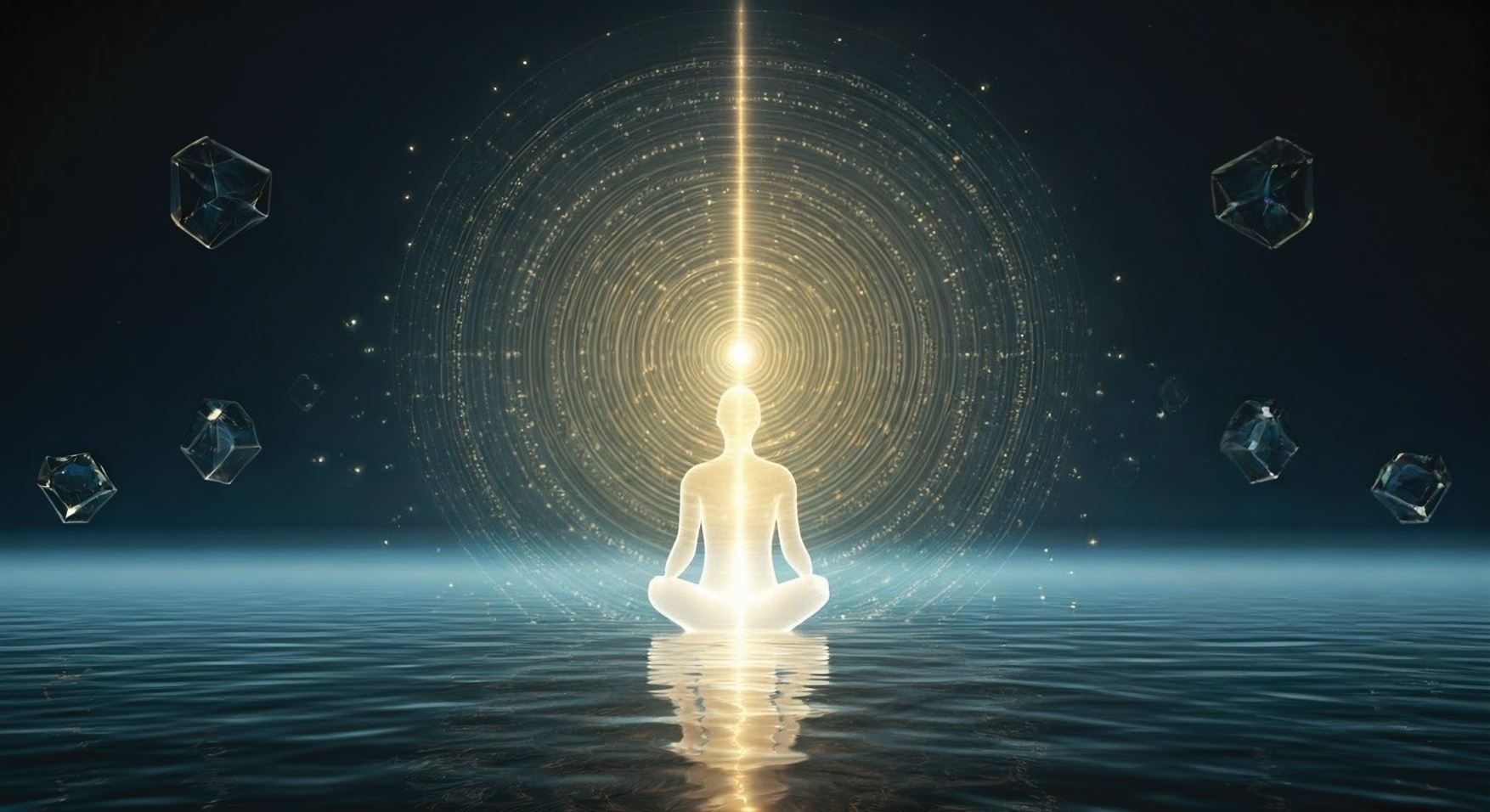
One of the principal principles of the Advaita Vedanta is that Brahman is the ultimate, undivided reality underlying all of existence.
The classic, Chandogya Upanishad, says:
“This is everything indeed Brahman. (sarvam khalvidam brahma)
Another Mahavakya states:
“Tat Tvam Asi” or Thou art That.
These sentences reveal the underlying unity of existence, despite the seeming diversity. Quantum physics too exhibits a remarkable interconnectivity. The periodic table is a statement of the identical quantum principles that control every atom in the cosmos. The same mathematics governs all chemical reactions, all living cells and all stars.
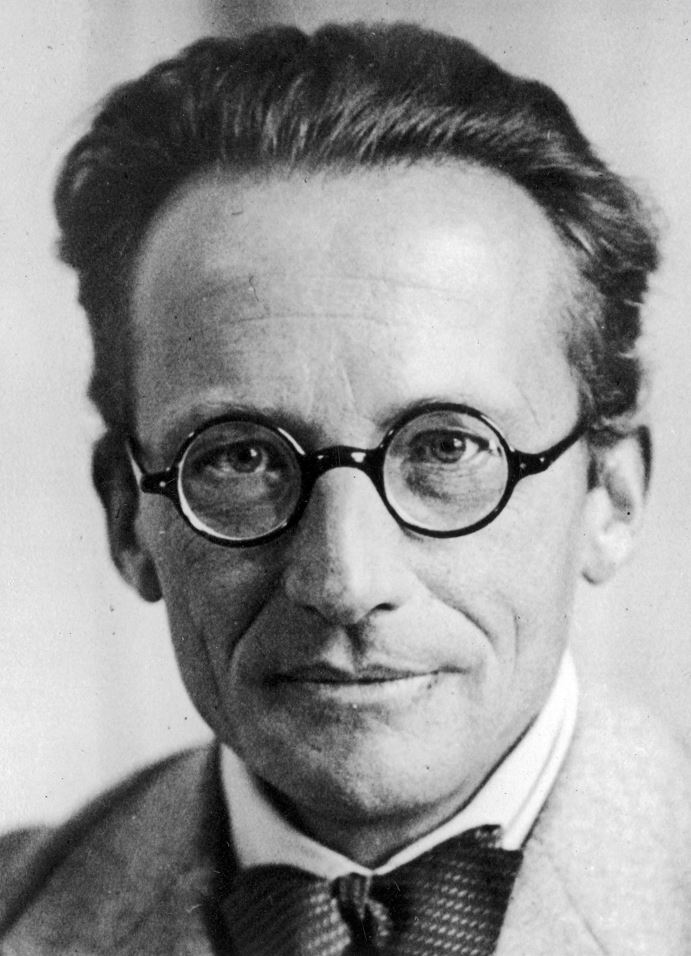
Image Courtesy: Wikimedia Commons
Quantum entanglement, even more surprisingly, is when two particles become so closely associated that measurement of one is correlated with measurement of the other, over great distances. Einstein famously dismissed this as ‘spooky action at a distance’. Today, entanglement underpins quantum cryptography, quantum teleportation, and emerging quantum computing technologies. Yet one must resist the temptation to equate entanglement with Vedantic unity. Entanglement is a precisely defined physical phenomenon described mathematically and verified experimentally. Brahman is a metaphysical concept concerning the nature of existence. Their resemblance lies in philosophical metaphor, not scientific identity.
MAYA AND THE NATURE OF APPEARANCE
Advaita Vedanta describes the phenomenal world as Maya, which is mistranslated in popular culture as ‘illusion’, implying that the world does not exist. That’s incorrect. Instead, Maya refers to the way reality is perceived through restricted perception. The world is real at the empirical level but does not represent ultimate reality. Interestingly, quantum physics offers an analogous lesson. Matter appears solid. Yet atoms consist mostly of empty space. Electrons cannot be described adequately as either particles or waves. Colour exists not within objects themselves but emerges through interactions between light, matter and the human visual system.
The familiar world is therefore an emergent reality arising from deeper physical processes invisible to our senses. Modern science and Vedanta both warn us not to treat appearances as the full account of reality. They arrive at this revelation, however, by rather different routes—experimental research on one side, philosophical reflection on the other.
THE OBSERVER PROBLEM
Few subjects have been so badly understood as the role of the observer when dealing with quantum mechanics. The Copenhagen Interpretation is that measurement causes the wave function to provide a definite consequence. This has been misinterpreted by certain well-known writers to indicate that human consciousness produces reality. There is no evidence for this assertion in mainstream physics.
In current quantum theory, an observer does not need to be a conscious being. In many cases, simply the interaction with measuring devices or the environment is enough to cause visible results, through processes such as decoherence. Physicists including Sean Carroll, David Deutsch and Carlo Rovelli have repeatedly cautioned against introducing consciousness into quantum mechanics without empirical evidence.
Indian philosophy, however, gives consciousness a fundamentally different status. Advaita identifies consciousness as the ultimate reality. Yoga regards consciousness as directly accessible through disciplined meditation. Buddhism analyses awareness as a dynamic process without an enduring self. These traditions investigate consciousness from the first-person perspective. Science investigates it from the third-person perspective. Both approaches remain valuable, but they answer different questions.
CONTEMPORARY PHYSICISTS ON QUANTUM MYSTICISM
Several leading physicists have addressed the growing tendency to associate quantum mechanics with spirituality. Nobel laureate Steven Weinberg warned against using quantum mechanics to justify metaphysical claims unsupported by evidence. Theoretical physicist Sean Carroll argues that quantum mechanics is already strange enough without invoking mystical explanations. Carlo Rovelli, one of the founders of relational quantum mechanics, emphasises that quantum theory describes relationships between physical systems rather than hidden spiritual realities. Similarly, Nobel laureate Roger Penrose, while deeply interested in consciousness, has consistently distinguished speculative hypotheses from established physics. These scientists do not dismiss philosophy. Rather, they insist upon preserving the methodological boundaries separating scientific theories from metaphysical reflection.
LESSONS FOR THE 21ST CENTURY
We are in an age of extraordinary technological change. Quantum computing could transform health, cryptography and artificial intelligence. More and more neuroscience is studying consciousness. Artificial intelligence is disturbing our long-held notions about intelligence itself. In such times the dialogue between scientific knowledge and philosophical understanding is more and more valuable. Not because ancient scriptures covertly held quantum physics. Not because equations validate spirituality. But since both traditions advocate humility. Quantum mechanics serves as a reminder that intuitions can be wrong. Indian philosophy warns us that perception may not be all of reality. Both arouse wonder rather than assurance. Both prize diligent investigation over dogmatism.
A SHARED SPIRIT OF CURIOSITY
Erwin Schrödinger was not looking for spiritual affirmation when he came up with his famous equation. He wanted a mathematical explanation of the world. But his later philosophical writings show a scientist grappling with the most ancient issues of mankind. He revered Vedanta, but he did not let that interfere with scientific discipline. It was more a demonstration of his idea that science and philosophy together increase our grasp of being. Perhaps this is the most enduring lesson of all.
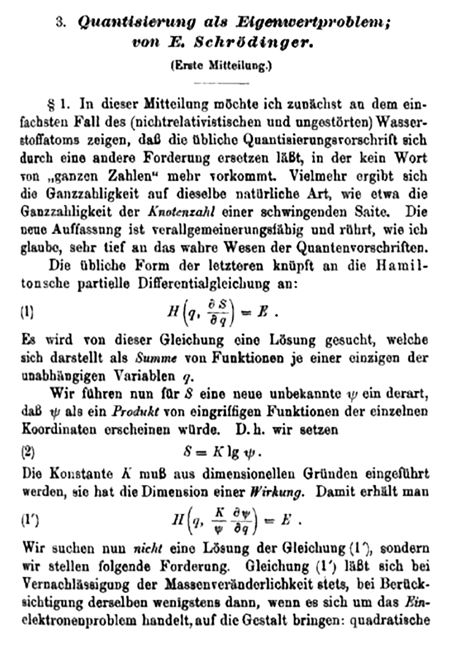
Image Courtesy: geschichte.univie.ac.at
The Schrödinger equation is one of the greatest triumphs of modern science, predicting experimental observations with exceptional precision. The Upanishads are still one of the greatest philosophical works of man because they force you to think deeply about the nature of consciousness and being. They are not interchangeable. But they do remind us that there are many methods to get to reality—mathematics, experiment, contemplation, and reason. As science continues to probe the quantum world and philosophy continues to explore the inner world, the dialogue between them should be guided not by sensational claims but by careful scholarship, mutual respect and intellectual honesty. The true meeting point of Schrödinger’s equation and Indian philosophy is not that one proves the other. It is that both invite us to recognise how much remains unknown. In an age of information overload that is often short on wisdom, that shared humility may be their greatest gift to humanity.
*The writer is an adjunct faculty at the National Institute of Advanced Studies, IISc campus, Bengaluru, and the Dean-Academic Affairs, Garden City University, Bengaluru. He can be reached at bijudharmapalan@gmail.com.